Weekly work wrap-up: a simple habit that improves focus, reflection, and follow-through
A weekly wrap-up that keeps me grounded
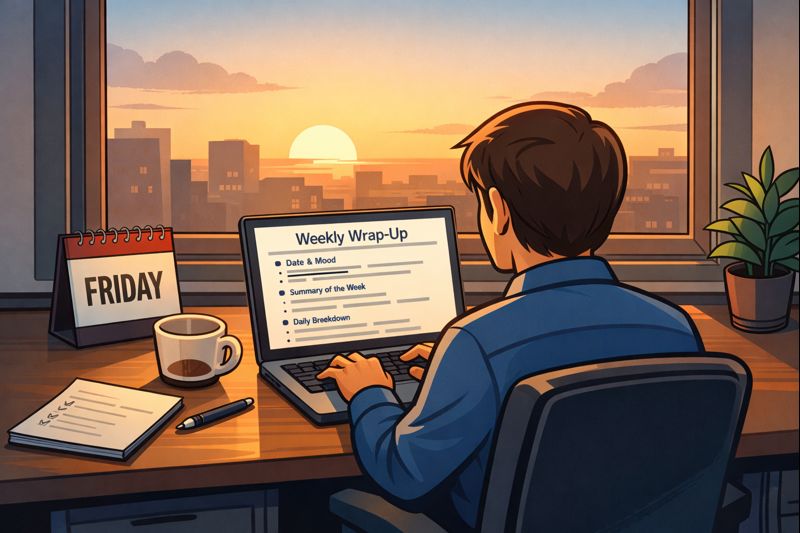
About a year and a half ago, I started a small habit: every Friday, I write a short wrap-up of my week. The goal was simple: understand where my time actually went, capture what I learned, and see if I could improve my focus. Over time, it became one of the most reliable routines I have for reflecting and improving how I work.
How I do it
Every Friday, I copy a template and fill it in. I start by reviewing my calendar and notes, then I write a quick day-by-day recap. At the end, I maintain a small task list for next week. I deliberately avoid customer and colleague names. That way, if I later summarize it with AI, I am not risking leaking sensitive information.
The format I use
I iterated on a few versions over time. This is the one I currently use:
Weekly Work Wrap-Up
- Date and mood
- Date: (Today’s date, usually Friday’s)
- Mood at the time of writing: (How I feel as I start writing)
- Summary of the week
- Overview: (What mattered this week)
- Major accomplishments: (Things I or my team succeeded at, delivery or people-related)
- Challenges faced: (Issues I faced, delivery or people-related)
- Daily breakdown
- Monday
- Key tasks and activities: (Main activities based on my calendar)
- Important meetings and outcomes:
- (Meeting title)
- (Outcome and/or action points)
- Decisions and learnings:
- (Decisions or learnings likely to matter later)
- Tuesday
- Key tasks and activities:
- Important meetings and outcomes:
- Decisions and learnings:
- Wednesday
- Key tasks and activities:
- Important meetings and outcomes:
- Decisions and learnings:
- Thursday
- Key tasks and activities:
- Important meetings and outcomes:
- Decisions and learnings:
- Friday
- Key tasks and activities:
- Important meetings and outcomes:
- Decisions and learnings:
- Goals and tasks for next week
- Key goals and tasks:
- (This becomes my running task list, see Benefit 5)
- Reflections
- What went well:
- What could be improved:
- Overall satisfaction and takeaways:
- (This is often different from the mood at the start, in both good and bad ways)
- Additional notes
- (Rarely used, but useful for links or context I want to keep)
Benefit 1: Continuity into the next week
On Monday, I read the previous wrap-up. It immediately restores context: what was happening, what mattered, and what I intended to do next. It is a simple way to avoid spending Monday morning reconstructing Friday.
Benefit 2: Closure before the weekend
Before I started doing this, I often carried unresolved work thoughts into the weekend. The wrap-up gives my brain a place to “park” everything: what happened, what is pending, and what I will do next. Once it is written, it is much easier to mentally switch off.
Benefit 3: A personal retrospective
Retrospectives work for teams because they create learning loops. A weekly wrap-up does something similar at an individual level. It forces a small moment of reflection: what actually happened, what went well, what did not, and what I want to change going forward. Over time, those small adjustments compound.
Benefit 4: Input for Personal Development conversations
At Eficode, we had a Personal Development Talk (PDT) every six months. I tried an experiment: I gave a custom GPT my weekly wrap-ups for the period as content, then fed it the PDT questions.
What I noticed:
- My own answers were heavily biased toward the last 2 to 3 weeks.
- The GPT produced more balanced answers across the whole period.
- It was also good at spotting patterns over time (mood shifts, recurring challenges, and how earlier decisions and learnings played out later). I still prefer writing the template myself first, but I then use the custom GPT to cross-check and refine what I wrote.
Benefit 5: It became my task list
I quickly realized that keeping my to-do list at the bottom of the weekly wrap-up was an easy way to keep it alive. Throughout the week, I add tasks, planned or unplanned, and keep the list up to date. When I complete an item, I strike it through instead of deleting it. At the end of the week, this makes it easy to see progress, whether the list is growing, and what I should prioritize next. During reflection, forgotten tasks often surface naturally and can be captured immediately.
If you try it
If you want to test the habit, start small. Put a 15-minute calendar block on Friday about one hour before you finish work, and treat it as a non-negotiable review. A few colleagues adopted the same routine after I shared it internally, and it stuck for them as well. If you do try it, I would be interested to hear what format you end up with.